Well I wrote a whole thing on this, but when I went to save it, through a terrible auth/login experience of this blog, it wiped out the entire thing. So I'm rewriting part of it in a deeply apathetic state.
Usability
Purely fueled by my avoidance to disappoint people, the growing number of testers, and deeply embarassing email chains of explaining a horrid onboarding experience and doc suite, I set out to improve the overall UI/UX.
In addition to re-skinning the entire product, I added things like hardware updates from the UI (even OTA updates to the receivers.. which is fun..), a nice website and a wiki that I thoroughly look forward to keeping updated. At this point, the idea of sending hardware is something I feel much less guilty about, as there is at least something to go off of vs. "Youll figure it out".
Dongle Revision
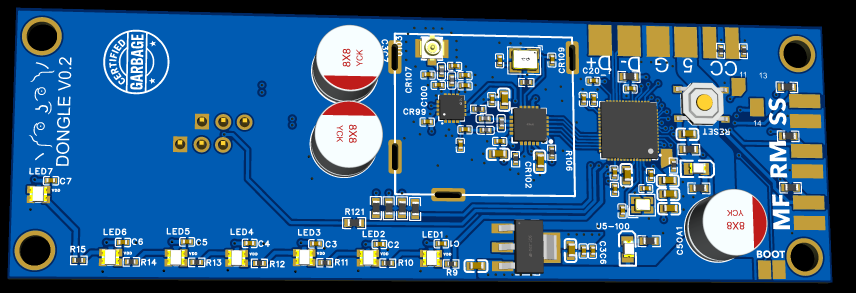
So with 433mhz, the dongle never really worked right. Mostly because I'd reverse engineered an FS1000A transmitter wrong to make it, but more broadly because I really wasnt prioritizing the 433mhz side of development. So I put some work in. The UI got a rework here too, making the experience around 433mhz (bilusocn etc) receivers less batshit confusing. What I also did was redesign the dongle around using an RF daughter board instead of an onboard circuit. Someday ill put it back on board, but for now I pinned the board out to accept 1 of 3 common 433mhz daughter boards (STX882, SYN115, and H34S-433). So there's that, and some more changes:
More Pads - Generally I exposed more GPIO as solder pads for folks, as that was a common ask.
Battery Sense Voltage Divider In service of standalone setups with a pi, it was demeed helpful to put some passives on there to allow the dongle to sense the voltage of an attached battery.
No more edge mounted SMA Again, in service of other form factors, I've decided to no longer mount the SMA connector to the edge of the board. It now uses an IPEX connector, which ill then buy a bunch of IPEX->SMA bulkhead whips to use. The daugher boards will use the same bulkhead. This largely simplifies folks making custom enclosures, as they just need to worry about the LEDs and screw holes as far as the location goes. Also, it was incredibly easy to break the edge-connected antenna and when you did, the dongle was broken and you needed a completely new board.
So without further adieu - the v0.2 dongle: 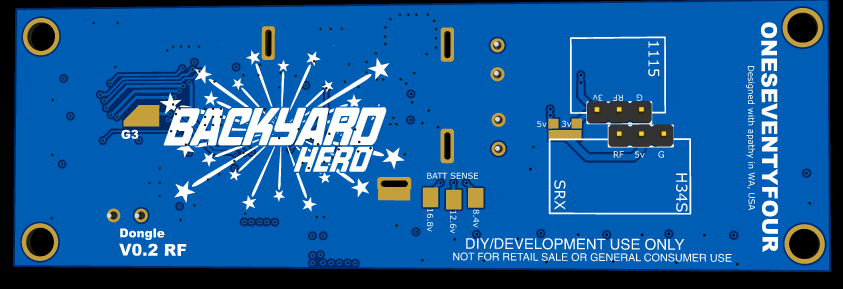
Standalone support
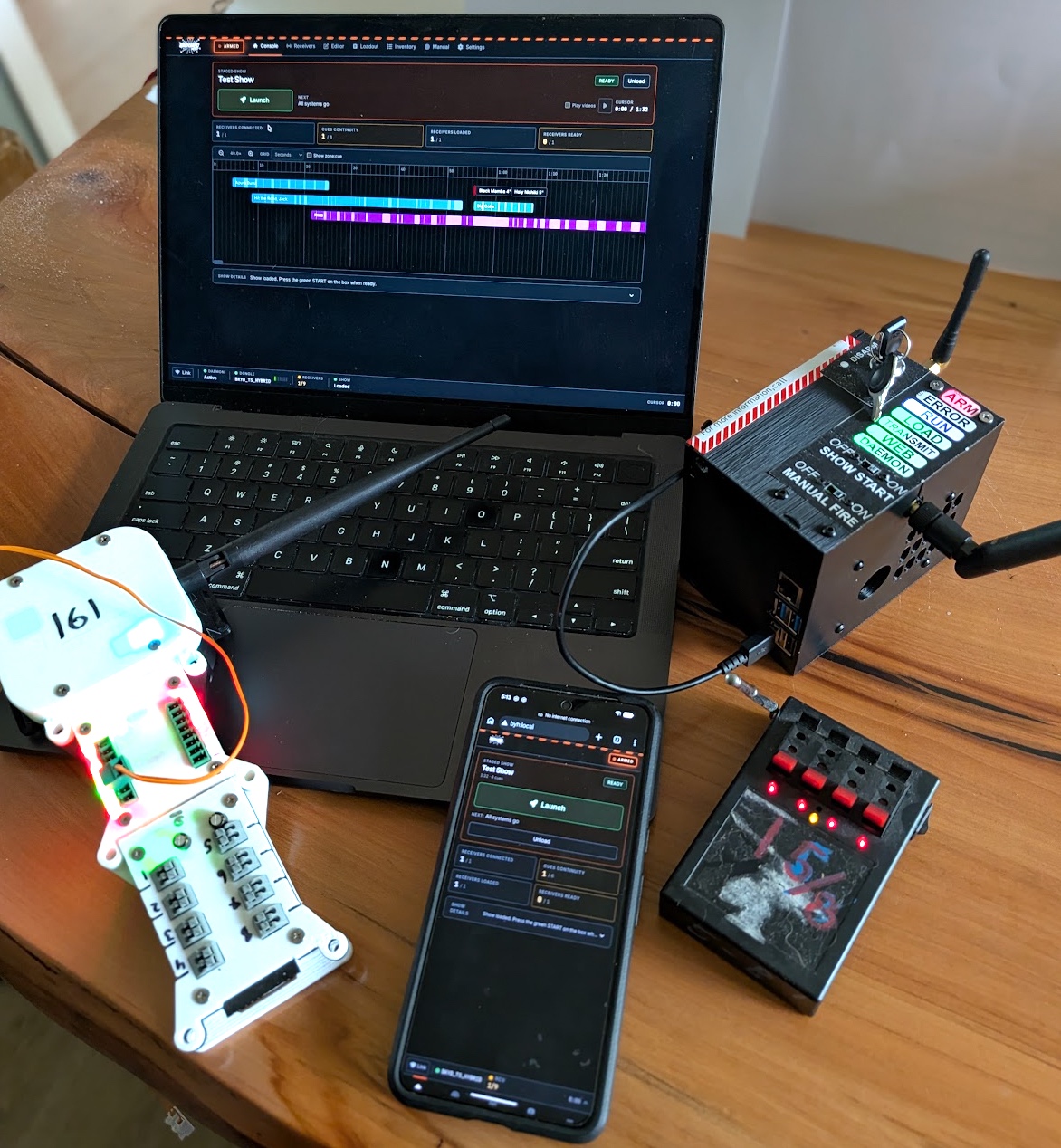 In a true return to form to the original, I built another standalone prototype. This funny enough is the same functionality that was previously packed into a pelican case, now in just a 4x4x3 inch cube. The cube is packed tight with a 10ah 12.4v battery (enough to run around 10 hours), a Raspberry pi with active cooling, a dongle board, and all the switches, antennas and whatnot. The hardware was the easy part, but now working with a standalone unit made me need to solve the following problems:
Wifi Configuration - As it needs to be connected to, the UI needs to be able to configure the WiFi. It does now! NTP Clock issues - Because a pi's clock can't be trusted to be the same as the device looking at it, and the fact that 'stale' on the dongle side largely relies on time deltas, a lot of that needed to be re-thought to work with the standalone unit. Mobile app/view - A realistic use of this is that one builds a show at home with a laptop connected to the standalone host, then goes out to the field, connecting to the unit with their phone and running the show that way. So we need a mobile experience.
and a bunch of other stuff. But it
